When it comes to bills adding up and just trying to pay rent... For a college student, "Does how much minimum wage is matter anymore?" You will find that today's college student will have not just one, but two or three jobs in order to make ends meet. A student of mine said that she is looking for a third job just to have some extra spending money to go out on the weekends.
In class yesterday we talked about Cultural Capital and how some communities are wealthy while others are poor. It's strange that at least while in college, the culture is the college campus and students will do whatever it takes to enjoy the college culture experience!
Do we even talk minimum wage anymore?http://www.usatodayeducate.com/staging/index.php/ccp/for-students-more-than-just-a-wage-2
Tuesday, February 12, 2013

Sunday, February 10, 2013
Growing number of HSIs
The number of Hispanic Serving Institutions has increased greatly:
http://www.hacu.net/NewsBot.asp?MODE=VIEW&ID=1235
http://www.hacu.net/NewsBot.asp?MODE=VIEW&ID=1235
Friday, February 8, 2013
Immigration reform and the impact on higher education
The article below gives us a good idea of what may be the impact of the proposed immigration reform on higher education. This strikes a personal chord with me because I was in a visa for so long (15 years), first as a student and then as a worker. Just recently (last May) I got my green card which was sponsored by U of I. In case that had not happened, I probably was going to see how I could have gotten one under this reform. What's interesting to me from the article is how potentially only STEM graduates will have a quicker pathway to a green card. How about other graduates? Why is STEM more important than education for instance? Well we have discussed a bit about that but this will be just another arena where STEM is being given preferential treatment over other subjects. The one thing I always had as a benefit to be in higher education is that the yearly quotas they currently have for work visas do not apply for those in education fields.
Anyway, Read the article here and chime in!
Anyway, Read the article here and chime in!
Thursday, February 7, 2013
What Happens to a Dream Deferred?: The future of TRIO
TRIO, founded in the late 1960's, describes three federally funded education initiatives for low-income, first generation students. Talent Search, Upward Bound, and Student Support Services emerged out of the Higher Education Act of of 1965 and 1968 amendments (Office of Post Secondary Education, 2011). Years later, the Ronald. E. McNair Post-Baccalaureate Program, Educational Opportunity Programs, and Upward Bound Math and Science were developed as part of the TRIO initiative.
The mission of TRIO is to provide baccalaureate and post-baccalaureate opportunities by offering academic and financial support, pathways, and research opportunities that help students realize the dream of higher education. TRIO programs help students level the playing field by providing the cultural capital needed to navigate the college and post-baccalaureate preparation and application process.
Budget cuts threaten the future of this program, as the federal government is set to seize 43 million dollars from TRIO on March 1, 2013. In the Diversity of Higher Education February 6, 2013 article, "TRIO Support Advocates Seek Support in Congress", members of the Congressional TRIO Caucus are advocating for the support of this initiative, siting its history of creating pathways for college access and success and helping young people who may otherwise be crushed by an unjust system, have a fighting chance. See article here: TRIO Program Advocates Seek Support in Congress
In my professional role at The Pennsylvania State University, I have had the opportunity to work with Ronald E.McNair students. These are amazing students who conduct intensive research throughout the school year with world-renowned faculty in preparation for graduate school. In addition, the McNair program assists and develops students so they are prepared academically, socially, and mentally for the challenges of the post-baccalaureate degree. They are now in graduate school or graduates of the nations top institutions, such as Yale, University of Georgia, Johns Hopkins, and University of Illinois at Urbana-Champaign . What happens to students, if Ronald E. McNair is cut or the number of slots greatly reduced? Will these same students still gain access to graduate education? Probably. Will they be as prepared and socialized for the graduate role as they are now when competing against applicants who have had research experience? Maybe,maybe not.
This is the story of so many young people in middle, high school, and college for whom access is afforded through the TRIO initiative. What happens when students are no longer provided an opportunity to develop and advance the skills needed to be admitted and graduate from college? As scholars, what can we do to advocate for dollars so that initiatives such as TRIO can move forward without the threat of financial seizure?
Is this a public good or a private matter?
What happens to a dream deferred?
Does it dry up
like a raisin in the sun?
Or fester like a sore--
And then run?
Does it stink like rotten meat?
Or crust and sugar over--
like a syrupy sweet?
Maybe it just sags
like a heavy load.
Or does it explode?
-Langston Hughes
The mission of TRIO is to provide baccalaureate and post-baccalaureate opportunities by offering academic and financial support, pathways, and research opportunities that help students realize the dream of higher education. TRIO programs help students level the playing field by providing the cultural capital needed to navigate the college and post-baccalaureate preparation and application process.
Budget cuts threaten the future of this program, as the federal government is set to seize 43 million dollars from TRIO on March 1, 2013. In the Diversity of Higher Education February 6, 2013 article, "TRIO Support Advocates Seek Support in Congress", members of the Congressional TRIO Caucus are advocating for the support of this initiative, siting its history of creating pathways for college access and success and helping young people who may otherwise be crushed by an unjust system, have a fighting chance. See article here: TRIO Program Advocates Seek Support in Congress
In my professional role at The Pennsylvania State University, I have had the opportunity to work with Ronald E.McNair students. These are amazing students who conduct intensive research throughout the school year with world-renowned faculty in preparation for graduate school. In addition, the McNair program assists and develops students so they are prepared academically, socially, and mentally for the challenges of the post-baccalaureate degree. They are now in graduate school or graduates of the nations top institutions, such as Yale, University of Georgia, Johns Hopkins, and University of Illinois at Urbana-Champaign . What happens to students, if Ronald E. McNair is cut or the number of slots greatly reduced? Will these same students still gain access to graduate education? Probably. Will they be as prepared and socialized for the graduate role as they are now when competing against applicants who have had research experience? Maybe,maybe not.
This is the story of so many young people in middle, high school, and college for whom access is afforded through the TRIO initiative. What happens when students are no longer provided an opportunity to develop and advance the skills needed to be admitted and graduate from college? As scholars, what can we do to advocate for dollars so that initiatives such as TRIO can move forward without the threat of financial seizure?
Is this a public good or a private matter?
like a raisin in the sun?
Or fester like a sore--
And then run?
Does it stink like rotten meat?
Or crust and sugar over--
like a syrupy sweet?
like a heavy load.
-Langston Hughes
UI proposing China-funded 'Confucius Institute' on campus
This article will address mixed feelings in regards
to a decision to possibly bring a 'Confucius Institute' to the campus for the
Chinese students. Does this mean that UIUC will accommodate all international populations
if their governments are willing to fund the institute that will improve their
language proficiency or at least the top three? Is it because China is now
standing as number one with a total of 4,257 students on UIUC campus for international
students? What about the other two populations that stand in the top three,
Korean students at 1,153 and Indian students at 1,122? Is it all about the
funds that UIUC will acquire if this happens? I am sure there are mixed
emotions about the latest news for UIUC.
Please view post and tell me what you think.
View site:
http://www.news-gazette.com/news/education/2013-02-06/ui-proposing-china-funded-confucius-institute-campus.html
View site:
http://www.news-gazette.com/news/education/2013-02-06/ui-proposing-china-funded-confucius-institute-campus.html
Wednesday, February 6, 2013
Duke fraternity hosts controversial party
This
past weekend (Feb. 1) a fraternity of the campus of Duke University hosted an
Asian themed party. The controversial party was preceded by an ethnically
insensitive invitation, inviting students to attend "Asia Prime."
Asian students on campus voiced their concerns and the administration suggested
that the fraternity not proceed with the party. The fraternity obliged.
Scrapping the original theme of the party, the fraternity decided to host
"International Relations. A celebration of all cultures and the diversity
of Duke". "...A rose by any other name..."
This
seems to be a reoccurring theme. A fraternity or sorority hosts a themed party
based on the stereotypes of others. The University issues a statement on how
they are committed to diversity and that measures will be put into place to
ensure that situations like this do not occur in the future. And then it
happens again. Are these parties just examples of colleges students having fun?
or is this pure, unadulterated racism? How do scenarios like these impact your perspective of diversity?
This all reminds me of a quote by Fredrick Douglas, “ It has been called a great many names, and it will call itself by yet another name; and you and I will and all of us had better wait and see what new form this monster will assume, in what new skin this old snake will come forth.”
Source(s):
http://news.yahoo.com/blogs/lookout/duke-racist-rager-141248540.html
http://www.dukechronicle.com/article/duke-kappa-sigma-party-ignites-firestorm-criticism
Tuesday, February 5, 2013
The New Wave of Technology
I saw my first computer inside of a classroom in the eighth grade, and then only teachers had access to them. Our view of the world back in the 80's and early 90's was through old text books, film on projector reels, VCR/TV's on a cart that teachers pushed from class to class, and overhead projectors that overheated if left on too long. When is the last time you saw your instructor actually write on the chalkboard.... What teachers/educators have access to now is awesome and simply phenomenal!
http://campustechnology.com/articles/2013/02/04/6-technologies-that-will-impact-higher-ed.aspx
http://campustechnology.com/articles/2013/02/04/6-technologies-that-will-impact-higher-ed.aspx
First African-American professor in Educational Leadership at Ole Miss
Sometimes I do wonder if we live in the 21st century! Shouldn't a headline like this be something out of the times we spoke in class yesterday? Can you think of other headlines like "first [insert race/ethnicity/gender]..." that are hard to believe that they still make headlines?
http://education.illinois.edu/news/Alumna-RoSusan-Bartee-UM-s-first-African-American-professor-Educational-Leadership
http://education.illinois.edu/news/Alumna-RoSusan-Bartee-UM-s-first-African-American-professor-Educational-Leadership
Monday, February 4, 2013
International student issues
This is a Chronicle article from last year that touches upon some issues related to international students and their (lack of) meaningful interaction with domestic students. The authors note that students from East Asia feel particularly marginalized. Since most of the international students at UIUC come from East Asia (particularly China and Korea), this is especially relevant to our institution. What do you think the university can do to help these students and their American counterparts?
http://chronicle.com/article/Many-Foreign-Students-Find/132275/
http://chronicle.com/article/Many-Foreign-Students-Find/132275/
Kaplan/U of I Discriminating Against Black Applicants?
In a previous class I conducted a study on U of I graduate students' financial literacy. I became interested in the topic after several of my friends found themselves with 0 dollar paychecks after having their wages garnished. The tax code states that up to $5,250 paid through an employer’s educational assistance program per calendar year can be excluded from an employee’s gross income. Anything beyond that should be treated as a taxable fringe benefit to the employee. Meaning, that tuition and fee waivers can be taxed up 30-35% (25% federal, 5% state, 5% social security). I focused my paper on financial literacy and I discovered finances can play a huge role in students matriculating toward degree completion. Literature tells us that the leading cause of student’s dropping out of college is due to funding and finances. Furthermore, young adults are not financially literate and therefore make bad decisions. Currently, student loans are at a record high, and so are the default rates.
Here at University of Illinois this waiver-tax issue disproportionately affects graduate students of color. Specifically, Graduate Employee Organization reports that 340 out of 9551 or 3.0% of graduate students are Black/ African American. Out of the 162 employees affected by the GA/PGA taxes 15.4 % are Black/African American which means that the tuition waiver is disproportionately impacting African American students by almost five times the level of their enrollment in the general graduate student population. Additionally, 65% of the people who are affected by the wage garnishment are women.
In my paper I argued that to not address this issue would be problematic in several ways. First, it violates the mission of Inclusive Illinois. Second, it could potentially effect the recruitment of graduate students to the University. Third, it could effect alumni investing back into their institution. Finally, it could have lasting effects on students as they graduate and try to cosumer markets (buying a house,car, etc) or jobs. As the article below discusses employers are now using credit scores to make hiring decisions.
Given these circumstances and possible consequences, does the university have a responsibility to be more intentional with exposing their students to a broad range of financial literacy topics so they are better prepared to meet the financial challenges of living as completely independent adult professionals?
http://www.nytimes.com/2013/01/30/business/judge-dismisses-suit-against-kaplan-over-hiring-practices.html?ref=education&_r=0
Here at University of Illinois this waiver-tax issue disproportionately affects graduate students of color. Specifically, Graduate Employee Organization reports that 340 out of 9551 or 3.0% of graduate students are Black/ African American. Out of the 162 employees affected by the GA/PGA taxes 15.4 % are Black/African American which means that the tuition waiver is disproportionately impacting African American students by almost five times the level of their enrollment in the general graduate student population. Additionally, 65% of the people who are affected by the wage garnishment are women.
In my paper I argued that to not address this issue would be problematic in several ways. First, it violates the mission of Inclusive Illinois. Second, it could potentially effect the recruitment of graduate students to the University. Third, it could effect alumni investing back into their institution. Finally, it could have lasting effects on students as they graduate and try to cosumer markets (buying a house,car, etc) or jobs. As the article below discusses employers are now using credit scores to make hiring decisions.
Given these circumstances and possible consequences, does the university have a responsibility to be more intentional with exposing their students to a broad range of financial literacy topics so they are better prepared to meet the financial challenges of living as completely independent adult professionals?
http://www.nytimes.com/2013/01/30/business/judge-dismisses-suit-against-kaplan-over-hiring-practices.html?ref=education&_r=0
Affirmative Action Ban Rejected
This was a court ruling at the end of last year that once again puts Michigan in the spotlight for affirmative action practices. As usual with these news, the comments section that follows also provide some interesting insight from readers. Check out the article in the link below:
http://www.insidehighered.com/news/2012/11/16/appeals-court-overturns-michigan-ban-affirmative-action
http://www.insidehighered.com/news/2012/11/16/appeals-court-overturns-michigan-ban-affirmative-action
Friday, February 1, 2013
University of Illinois Brings an Ex-Porn Star to Campus
While having lunch with the Director of the Study Abroad Office this week, she and I started having a great conversation about diversity on campus and the role that it plays for incoming and new students. She explained that a good friend of hers, the Director of Allen Hall (a Living-Learning Community), encourages and embraces diversity in all forms and is constantly advocating and researching, especially within her hall with all of her students. This coming Sunday she is hosting an event where Annie Sprinkle, an ex- pornstar and prostitute, is coming to speak to the residence of Allen Hall about her journey as a pornstar/prostitute to a now "ecosexual" (where she is in an intimate relationship with the Earth).
During lunch, we were talking about whether this is an educational experience for the students, or if the director, and the University, are over stepping their bounds. Is this diversity? Are we incorporating different cultures and experiences in hopes to help our students develop by providing this experience? Looking at Allen Hall's upcoming event calendar I see the likes of "Black History Month: Widows of MLK and Malcolm X" and "Bollywood Night", both of which are educational opportunities to teach students about other experiences and cultures, but seeing Annie Sprinkle's event amongst them seems to be out of place, or does it?
I wanted to share this with the class to see what your thoughts are in regards to diversity in higher education and how it relates to educating our students about diversity. Is the University of Illinois pushing the limit?
Annie Sprinkle's Website
Allen Hall Facebook Event Post
During lunch, we were talking about whether this is an educational experience for the students, or if the director, and the University, are over stepping their bounds. Is this diversity? Are we incorporating different cultures and experiences in hopes to help our students develop by providing this experience? Looking at Allen Hall's upcoming event calendar I see the likes of "Black History Month: Widows of MLK and Malcolm X" and "Bollywood Night", both of which are educational opportunities to teach students about other experiences and cultures, but seeing Annie Sprinkle's event amongst them seems to be out of place, or does it?
I wanted to share this with the class to see what your thoughts are in regards to diversity in higher education and how it relates to educating our students about diversity. Is the University of Illinois pushing the limit?
Annie Sprinkle's Website
Allen Hall Facebook Event Post
Lack of Diversity in Faculty at Penn
The University of Pennsylvania president, Amy Gutmann, has stated her commitment to diversity in the administration at UPenn. When the university hired a white male to become the dean of the School of Arts and Sciences, many faculty perceived this hire as an opposition to Gutmann's stated mission. This group of faculty are also frustrated because they do not know why the university chose this candidate over others. One faculty member at the university makes the point that there certainly are people of color who are qualified for the dean position so the argument that it is a challenge to find qualified people of different backgrounds is moot. This reminds me of when head football coach, Tim Beckman, was hired at Illinois and there was controversy over his hire because Illinois has yet to have a head football coach who is a person of color. The Daily Illini followed this story. Two trustees in particular cited the disconnect between the university's diversity initiative and their actions and follow through with those initiatives. Although we as a class have not touched on faculty diversity yet (it appears we will later on in the semester) I encourage you to think about diversity in educational leadership positions, not just from the stance of race, but also ability, gender, sexual orientation, religion, etc. What effect could lack of diversity in faculty and leadership have on students? Should universities focus on diversifying the student body more than focusing on diversifying the leadership? Or vice versa? In relation to our last class discussion, do you think this issue of diversity in faculty and administration has any link to persistence and access?
Inside Higher Ed article: http://www.insidehighered.com/news/2013/01/31/minority-faculty-university-pennsylvania-question-presidents-commitment-diversity
Brief Daily Illini article (there are many stories written on the issue): http://www.dailyillini.com/sports/article_6ac6016e-8f95-504f-a41e-cabd60084e58.html
Inside Higher Ed article: http://www.insidehighered.com/news/2013/01/31/minority-faculty-university-pennsylvania-question-presidents-commitment-diversity
Brief Daily Illini article (there are many stories written on the issue): http://www.dailyillini.com/sports/article_6ac6016e-8f95-504f-a41e-cabd60084e58.html
Thursday, January 31, 2013
State of Florida Considers Tiered Tuition
The state of Florida is considering implementing a tier system for tuition. This means that certain majors would be offered at a lower cost (with the remainder subsidized by tax payers) in an effort to motivate more students to pursue careers in STEM. The argument in favor of this policy is to prepare more graduates for high-demand jobs that will bolster Florid's economy and make Florida business more globally competitive.
Although not inherently "racist," this policy devalues other disciplines of study such as arts, humanities and ethnic studies. Furthermore, students of color and women are severely underrepresented in STEM fields. This could mean that these already marginalized populations would be forced to pay more for school unless they choose a career in the math or sciences--areas of study that have traditionally not supported these students. What do you think of this policy? Should Florida implement it? What would be the impications? Do policies such as tiered tuition support a "public good" or "private return?"
http://www.nytimes.com/2012/12/10/education/florida-may-reduce-tuition-for-select-majors.html?pagewanted=all&_r=0
“The higher education system needs to evolve with the economy,” said Mr. Brill, the president of the Florida Chamber Foundation. “People pay taxes expecting that the public good will be served to the greatest degree possible. We call that a return on investment.”
https://www.change.org/petitions/governor-rick-scott-protect-higher-education-in-florida
What does this mean? The central idea du jour emerging from the task force is a “differentiated tuition structure to support degree programs in strategic areas of emphasis.” The state, the task force argues, “should move away from uniform tuition rates … among all degree programs within a university.” Programs with no tuition increase would be those deemed “high skill, high demand, and high wage.” Liberal arts and social science topics (English, History, Political Science, Psychology, etc.) would cost students more, on the assumption that no one with such a degree has high skills, would ever be in high demand, and would ever earn a high wage, however “high” is defined. As Proctor himself put it on October 29, “English is not a strategic discipline.” As tuition for such non-strategic disciplines increases, these programs would be slowly phased out, or at least severely diminished, as more students seek “strategic degrees.” This new thinking will supposedly solve the financial problems of Florida’s universities while somehow improving the economy of the state.
Although not inherently "racist," this policy devalues other disciplines of study such as arts, humanities and ethnic studies. Furthermore, students of color and women are severely underrepresented in STEM fields. This could mean that these already marginalized populations would be forced to pay more for school unless they choose a career in the math or sciences--areas of study that have traditionally not supported these students. What do you think of this policy? Should Florida implement it? What would be the impications? Do policies such as tiered tuition support a "public good" or "private return?"
http://www.nytimes.com/2012/12/10/education/florida-may-reduce-tuition-for-select-majors.html?pagewanted=all&_r=0
“The higher education system needs to evolve with the economy,” said Mr. Brill, the president of the Florida Chamber Foundation. “People pay taxes expecting that the public good will be served to the greatest degree possible. We call that a return on investment.”
https://www.change.org/petitions/governor-rick-scott-protect-higher-education-in-florida
What does this mean? The central idea du jour emerging from the task force is a “differentiated tuition structure to support degree programs in strategic areas of emphasis.” The state, the task force argues, “should move away from uniform tuition rates … among all degree programs within a university.” Programs with no tuition increase would be those deemed “high skill, high demand, and high wage.” Liberal arts and social science topics (English, History, Political Science, Psychology, etc.) would cost students more, on the assumption that no one with such a degree has high skills, would ever be in high demand, and would ever earn a high wage, however “high” is defined. As Proctor himself put it on October 29, “English is not a strategic discipline.” As tuition for such non-strategic disciplines increases, these programs would be slowly phased out, or at least severely diminished, as more students seek “strategic degrees.” This new thinking will supposedly solve the financial problems of Florida’s universities while somehow improving the economy of the state.
Wednesday, January 30, 2013
First Ever LGBT Class Begins At Morehouse College: Students Voice Their Reaction
An interesting at Morehouse College where there is a course (for the first time in its history) on being offered on LGBT culture and identity. This follows significant controversy last year about the rights of gay and transgender students to express themselves on campus. Morehouse is known for both its connection to the civil rights movement (via Martin Luther King, Jr., Benjamin Mays and others) and its conservative culture among administration leaders. The comments following the story reflect the tension between the LGBT and conservative Black community. Thoughts?
Link: http://www.blackbluedog.com/2013/01/news/first-ever-lgbt-class-begins-at-morehouse-college-students-voice-their-reaction/
Link: http://www.blackbluedog.com/2013/01/news/first-ever-lgbt-class-begins-at-morehouse-college-students-voice-their-reaction/
Saturday, January 26, 2013
Generation LGBTQIA
In early January, the New York Times ran an article about the "New LGBTQIA Generation."
An interest of mine has always been "concealable" underrepresented students, meaning students whose status cannot be readily identified by looking at them (i.e. sexual orientation, first generation, socioeconomic status, etc.)
The article not only raises awareness about the changing LBGTQ community but also potential impacts on college campuses.
So questions to think about while reading the article are:
1. Why do you think one mainstream "LBGTQ face" gets focused on?
2. What potential impacts do you think this article has on:
a. Campus Climates?
b. Best Practices among Colleges and Universities?
c. Recruitment of these "concealable" students
3. Is higher education putting too much/not enough emphasis on identity?
4. When we ask students to identify themselves are we encompassing both master identities and emergent identities?
The link to the article is below.
http://www.nytimes.com/2013/01/10/fashion/generation-lgbtqia.html?pagewanted=all&_r=1&smid=tw-nytimes&
Monday, January 21, 2013
On rankings of the College of Education @ the UIUC
On January 14th, the College of Education (COE) at the U of I shared the 2013 U.S. News and World Report Rankings. As a first year doctoral student who had been less keen on rankings when applying to graduate schools (other issues took priority in analysis), I was eager to learn how "my college" did. Only after opening the link and seeing the top image was when I became less interested in the college and more concerned about "my department". I automatically saw what was there - in the rankings - and what was not: EPOL. Once you visit the site you will notice how other departments within the COE rank among the top ten graduate programs. This is bittersweet for me. I am proud to be a student in such a great University, an inviting College, and an inclusive and diverse Department. Yet, I cannot avoid the emptiness I feel for what not being there represents.
As we may all know by now, EPOL is the most diverse Department on campus; there is a mixture of different minorities, international, non-traditional, aged, gendered, classed - and hopefully - queered students. At a moment in which we are discussing diversity in higher education, I think it is important that we reflect on what these rankings mean or do not mean, how they are perceived, and why they are used.
I argue that even among a department that seeks to provide as much access to higher education as possible, the findings in this report are not coincidental. I share this information not to criticize the Department, faculty, or fellow students, but rather as an example of how critical we should be when discussing issues on diversity. It is crucial to realize that there are indeed structural forces, power relations that take place even after we obtain access to higher education. As part of my comment on Dr. Baber's Jan. 14th post, I mentioned that as minorities we have to work twice as hard to get half as far. Do you think these rankings/stats resemble this?
As we may all know by now, EPOL is the most diverse Department on campus; there is a mixture of different minorities, international, non-traditional, aged, gendered, classed - and hopefully - queered students. At a moment in which we are discussing diversity in higher education, I think it is important that we reflect on what these rankings mean or do not mean, how they are perceived, and why they are used.
I argue that even among a department that seeks to provide as much access to higher education as possible, the findings in this report are not coincidental. I share this information not to criticize the Department, faculty, or fellow students, but rather as an example of how critical we should be when discussing issues on diversity. It is crucial to realize that there are indeed structural forces, power relations that take place even after we obtain access to higher education. As part of my comment on Dr. Baber's Jan. 14th post, I mentioned that as minorities we have to work twice as hard to get half as far. Do you think these rankings/stats resemble this?
Inauguration on MLK Day
http://www.clickondetroit.com/news/politics/Obama-s-2nd-inauguration-on-MLK-Day/-/1719386/18216612/-/ecyh94/-/index.html
We are not meeting this week so I wanted to discuss the MLK speech that was recommended reading. This was a fascinating and very humbling piece. I wanted to comment on the following excerpts:
Miller: Dr. King, another question, do you feel it is socially just to place a colored person in a high
position because of his color, bypassing in the same act many white men who have priority because of
their seniority?
Dr. King: So the first thing I'm concerned about is full employment for everybody. Now the Negro has sufferedmore because of automation than whites because the Negro, with limited educational opportunities and having been denied apprenticeship training in so many instances and outright discrimination, has been
limited to unskilled and semi‐skilled labor. In the day of automation, these are the jobs that are passing
away so the Negro gets a double for outright discrimination and automation doing away with certain
jobs. I'm concerned about full employment.
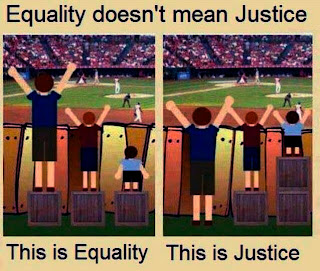
On the other hand, I think we must honestly face a fact if one gets behind in a race, he must eternally
remain behind or run faster than the man in front. You've got to give him the equipment to catch up.
Now the fact is that the Negro has had 244 years of slavery in America and working without wages and
then he's had a hundred years of segregation and mistreatment in generally. Now, he's faced with a very
serious problem and that is that he is required to be as productive as people who have not had these
conditions and the only thing that a society can do for individuals who have been deprived of something
is to give them a little special treatment. Now you don't put anybody out of a job, but you just make it
possible for the individuals who are behind to catch up...
I think this is all we're saying that we have been deprived of something as a people and we have been
crippled because of this. We feel that America ought to give us a crutch until we can come to the point
of walking on our own rights...
And also:
Miller : Dr. Martin Luther King, we thank you for your presentation. The audience has indicated its
enthusiastic reception of your remarks. I might say here before I read the first question that Western
Michigan University gained the name of University de jure in 1957. What is much more difficult an
accomplishment is to get it de facto. Certainly, one aspect of it is to have a faculty and to have a student
body that can look at one another and see men and women and only men and women and not a social
class, or an economic class or a race or a creed or a national origin. This is what we seek. This is what a
university means. I like to think that we are making significant headway in that direction. I wouldn't say
we've reached the millennium but this is the goal and this is a proper goal of a university, the only goal
that it can seek in this respect.
The presidential inauguration falling on MLK day this year served as a vivid reminder of how far this nation has come in moving toward King's dream. For the second time, a black man was sworn in as president--a day many of our ancestors may have never believed would come. Does President Obama's second term indicate that African Americans have "caught up" so to speak? What about other marginalized groups?
Furthermore, if African Americans have caught up, then what is the role of higher education in providing services for underrepresented students, students of color and low-income students? Is the goal of a university as WMU President Miller suggested, "to look at one another and see men and women and only men and women and not a social class, or an economic class or a race or a creed or a national origin"? What end does this type of color-blind rhetoric hope to reach, and what role are to we to play in reaching it?
We are not meeting this week so I wanted to discuss the MLK speech that was recommended reading. This was a fascinating and very humbling piece. I wanted to comment on the following excerpts:
Miller: Dr. King, another question, do you feel it is socially just to place a colored person in a high
position because of his color, bypassing in the same act many white men who have priority because of
their seniority?
Dr. King: So the first thing I'm concerned about is full employment for everybody. Now the Negro has sufferedmore because of automation than whites because the Negro, with limited educational opportunities and having been denied apprenticeship training in so many instances and outright discrimination, has been
limited to unskilled and semi‐skilled labor. In the day of automation, these are the jobs that are passing
away so the Negro gets a double for outright discrimination and automation doing away with certain
jobs. I'm concerned about full employment.
On the other hand, I think we must honestly face a fact if one gets behind in a race, he must eternally
remain behind or run faster than the man in front. You've got to give him the equipment to catch up.
Now the fact is that the Negro has had 244 years of slavery in America and working without wages and
then he's had a hundred years of segregation and mistreatment in generally. Now, he's faced with a very
serious problem and that is that he is required to be as productive as people who have not had these
conditions and the only thing that a society can do for individuals who have been deprived of something
is to give them a little special treatment. Now you don't put anybody out of a job, but you just make it
possible for the individuals who are behind to catch up...
I think this is all we're saying that we have been deprived of something as a people and we have been
crippled because of this. We feel that America ought to give us a crutch until we can come to the point
of walking on our own rights...
And also:
Miller : Dr. Martin Luther King, we thank you for your presentation. The audience has indicated its
enthusiastic reception of your remarks. I might say here before I read the first question that Western
Michigan University gained the name of University de jure in 1957. What is much more difficult an
accomplishment is to get it de facto. Certainly, one aspect of it is to have a faculty and to have a student
body that can look at one another and see men and women and only men and women and not a social
class, or an economic class or a race or a creed or a national origin. This is what we seek. This is what a
university means. I like to think that we are making significant headway in that direction. I wouldn't say
we've reached the millennium but this is the goal and this is a proper goal of a university, the only goal
that it can seek in this respect.
The presidential inauguration falling on MLK day this year served as a vivid reminder of how far this nation has come in moving toward King's dream. For the second time, a black man was sworn in as president--a day many of our ancestors may have never believed would come. Does President Obama's second term indicate that African Americans have "caught up" so to speak? What about other marginalized groups?
Furthermore, if African Americans have caught up, then what is the role of higher education in providing services for underrepresented students, students of color and low-income students? Is the goal of a university as WMU President Miller suggested, "to look at one another and see men and women and only men and women and not a social class, or an economic class or a race or a creed or a national origin"? What end does this type of color-blind rhetoric hope to reach, and what role are to we to play in reaching it?

Wednesday, January 16, 2013
Thoughts on Gender
In our first meeting we separated into groups to discuss what makes us unique and how those experiences contributed to our educational paths. The Chronicle of Higher Education published an article today on Diversity in Academe and the desire to have more female philosophers in the classroom as well as in the field of Philosophy.
As I am interested in the opportunity for women to move forward in higher education (especially after reading this book the book Breaking Into the All-Male Club: Female Professors of Educational Administration), I felt that this article added to the discussion the perspective of teaching the classics. Regan Penaluna cut right to the salient issue in that women are more prevalent in the teaching of history and English since the issue of gender inequality can be discussed and put into a particular context, while this cannot be done for philosophy. Students in philosophy are studying the great arguments of Aristotle and find the commonality between the student and the philosopher. It is definitely difficult, as Penaluna describes, to identify "with a thinker who has exceptionally low expectations for you" (Penaluna, 2013, 9th paragraph).
Penaluna goes on to illustrate what educators can do to increase participation by women in the canon particularly attacking the misogyny that is apparent. It is my hope that department chairs and faculty are paying attention to the exclusion of women from the field and move quickly to correct what has been put in place.
As I am interested in the opportunity for women to move forward in higher education (especially after reading this book the book Breaking Into the All-Male Club: Female Professors of Educational Administration), I felt that this article added to the discussion the perspective of teaching the classics. Regan Penaluna cut right to the salient issue in that women are more prevalent in the teaching of history and English since the issue of gender inequality can be discussed and put into a particular context, while this cannot be done for philosophy. Students in philosophy are studying the great arguments of Aristotle and find the commonality between the student and the philosopher. It is definitely difficult, as Penaluna describes, to identify "with a thinker who has exceptionally low expectations for you" (Penaluna, 2013, 9th paragraph).
Penaluna goes on to illustrate what educators can do to increase participation by women in the canon particularly attacking the misogyny that is apparent. It is my hope that department chairs and faculty are paying attention to the exclusion of women from the field and move quickly to correct what has been put in place.
Monday, January 14, 2013
Subscribe to:
Posts (Atom)