Monday, January 14, 2013

Monday, May 7, 2012
Call him Dr. Shaq O;Neal
(CBS News) During his 19-year National Basketball Association career, Shaquille O'Neal's teams won four titles.
But now he's adding a new and different title: Doctor.
O'Neal dominated pro basketball, and used the fame he earned on the court as an entree to a lucrative career away from the hardwood, in movies and commercials.
In a recent ad for Buick, he said, "I've got shoes that are bigger than most hybrids - and more stylish, too."
O'Neal earned millions and became a household name but, through it all, he was working on another goal.
In a public service announcement for Barry University, from which he's graduating Saturday, he says, "You know me from my reputation on the court, but basketball is just a part of my life. I'm also a student."
O'Neal continues to keep a promise he made to his parents in 1992, when he left Louisiana State University for the pros after his sophomore year.
More than a decade after he began college, O'Neal received his Bachelor's degree from LSU, then went on to earn an MBA from the University of Phoenix.
On Saturday, he adds another impressive title: an Ed.D. - a doctorate in education.
And as he points out, it's a real degree, not an honorary one.
"When he was in class," says Barry University Associate Prof. Dr. David Kopp, "he was front-and-center, raising his hand. He had no problem fitting into the desk, which was my concern."
But no one was concerned about his commitment: Over four-and-a-half years, O'Neal took 16 courses, completed 54 credit hours and carried a grade point average of 3.8.
He now wants to be called "Dr. O'Neal" - because he's earned it.
© 2012 CBS Interactive Inc.. All Rights Reserved.
But now he's adding a new and different title: Doctor.
O'Neal dominated pro basketball, and used the fame he earned on the court as an entree to a lucrative career away from the hardwood, in movies and commercials.
In a recent ad for Buick, he said, "I've got shoes that are bigger than most hybrids - and more stylish, too."
O'Neal earned millions and became a household name but, through it all, he was working on another goal.
In a public service announcement for Barry University, from which he's graduating Saturday, he says, "You know me from my reputation on the court, but basketball is just a part of my life. I'm also a student."
O'Neal continues to keep a promise he made to his parents in 1992, when he left Louisiana State University for the pros after his sophomore year.
More than a decade after he began college, O'Neal received his Bachelor's degree from LSU, then went on to earn an MBA from the University of Phoenix.
On Saturday, he adds another impressive title: an Ed.D. - a doctorate in education.
And as he points out, it's a real degree, not an honorary one.
"When he was in class," says Barry University Associate Prof. Dr. David Kopp, "he was front-and-center, raising his hand. He had no problem fitting into the desk, which was my concern."
But no one was concerned about his commitment: Over four-and-a-half years, O'Neal took 16 courses, completed 54 credit hours and carried a grade point average of 3.8.
He now wants to be called "Dr. O'Neal" - because he's earned it.
Friday, May 4, 2012
Harvard and MIT Put $60-Million Into New Platform for Free Online Courses
Harvard and MIT Put $60-Million Into New Platform for Free Online Courses
May 2, 2012,

The group of elite universities offering free online courses just got bigger.
Harvard University and the Massachusetts Institute of Technology today announced a partnership that will host online courses from both institutions free of charge. The platform, its creators say, has the potential to improve face-to-face classes on the home campuses while giving students around the world access to a blue-ribbon education.
The new venture, called edX, grew out of MIT’s announcement last year that it would offer free online courses on a platform called MITx. The combined effort will be overseen by a nonprofit organization governed equally by both universities, each of which has committed $30-million to the project. Anant Agarwal, director of MIT’s Computer Science and Artificial Intelligence Laboratory, who led the development of MITx, will serve as edX’s first president.
Students who complete the courses on the edX platform will not receive university credit, although they could earn certificates.
At a news conference, the leaders of edX described it as a tool that colleges can use to experiment with online courses and study how students learn. For example, Mr. Agarwal said, in the prototype MITx course “Circuits and Electronics,” researchers “gather huge amounts of data” on students’ use of the platform, including how much time they spend watching videos.
Since edX courses have the potential to reach hundreds of thousands of students, the data sets could be “very statistically significant in a very short amount of time,” he said.
edX plans to host its first courses this fall, across an array of disciplines. Mr. Agarwal said the platform would allow colleges to join Harvard and MIT in creating brands with the “x” signifier, also would be offered as open-source software for institutions that want to build on it. It will be distinct from the continuing distance-education programs at Harvard and MIT, including Harvard’s Extension School and MIT’s OpenCourseWare, which has been putting course materials online for a decade.
L. Rafael Reif, MIT’s provost, said the driving force behind the partnership wa “not to make money” but to improve learning for both the universities’ traditional students and the public at large. But, he added, the project will need to find a way to support itself, and its leaders are exploring ways to help it be self-sustaining.
“Clearly, we want to make sure that this does not become a drain on the budgets of Harvard and MIT,” Mr. Reif said.
Other elite universities have attempted online-education programs that were closed after experiencing financial woes. Those efforts included Fathom, a project led by Columbia University that ended in 2003; and AllLearn, a collaboration that closed its doors in 2006.
The partnership between Harvard and MIT is one piece of an online-education revival among elite universities that has emerged in the past year. The edX announcement comes after four top-tier institutions teamed up last month with a for-profit company led by two Stanford computer-science professors to offer a similar array of free online courses. Stanford University, Princeton University, the University of Pennsylvania, and the University of Michigan at Ann Arbor announced the partnerships with Coursera, a company that sprouted from Stanford’s early experiments with massive open online courses.
George Siemens, associate director of Athabasca University’s Technology Enhanced Knowledge Research Institute and a pioneer of massive open online courses, as they are known, said the creation of edX represents in part an attempt by two universities to reclaim space in open online education, where venture capitalists have recently gained a foothold. While Coursera plans eventually to profit from its course offerings, he noted, it’s not yet clear how edX will support itself, and the model its leaders choose will dictate its longevity.
“Is there a sustainability model in place for these initiatives?” he asked. “Otherwise, it will end up being what happened with Fathom and others.”
Depending on how edX develops, Mr. Siemens said, the project may even begin to affect the basis for colleges’ accreditation. In a decade, he speculated, campus administrators may view this recent period of college investment in online-education projects as the moment when the alternative-credential model took off.
“It’s a natural progression of the Internet influencing and impacting what we thought was a pretty stable field,” he said. “But all it takes is six months of pretty surprising announcements in terms of open-course initiatives, and all of a sudden you can start to picture that education seems to be at the threshold of a very dramatic change.”
What are your personal views on on-line courses? Do you think this funding can be used for other educational purposes? Can on-line teaching have the same impact as in class teaching and instruction?
Gains in Access, Less in Success
Gains in Access, Less in Success
May 4, 2012 - 3:00am
In
2007 -- long before President Obama pushed to make college attainment a
national priority and three years before the phrase "completion agenda"
first appeared in these pages -- a group of public university systems put themselves on the spot.
Working with (and to some extent prodded by) Education Trust, which promotes the educational success of low-income and minority students, the 22 systems of two-year and four-year colleges and universities committed to increasing their attainment levels, in large part by closing the gaps in performance between underrepresented students and their peers within a decade. And they committed, too, to documenting their progress by collecting and publicly reporting detailed (and in some cases, previously unreported) data on student access and success.
In a report released Thursday, Education Trust and the National Association of System Heads, collaborators on the "Access to Success Initiative," lay out how the initiative as a whole and the individual systems have fared at roughly the midpoint of the project.
The results, as one might have predicted, are mixed. On the positive side, the 300-plus community and four-year colleges in the 22 systems collectively enrolled 42 percent more low-income students and 23 percent more black, Latino and American Indian students in 2009-10 than they did in 2005-6. The four-year institutions among the group's member systems also cut to 6 percent from 12 percent the difference between the representation of low-income students in their freshmen classes and the proportion of high school graduates who are from low-income backgrounds.
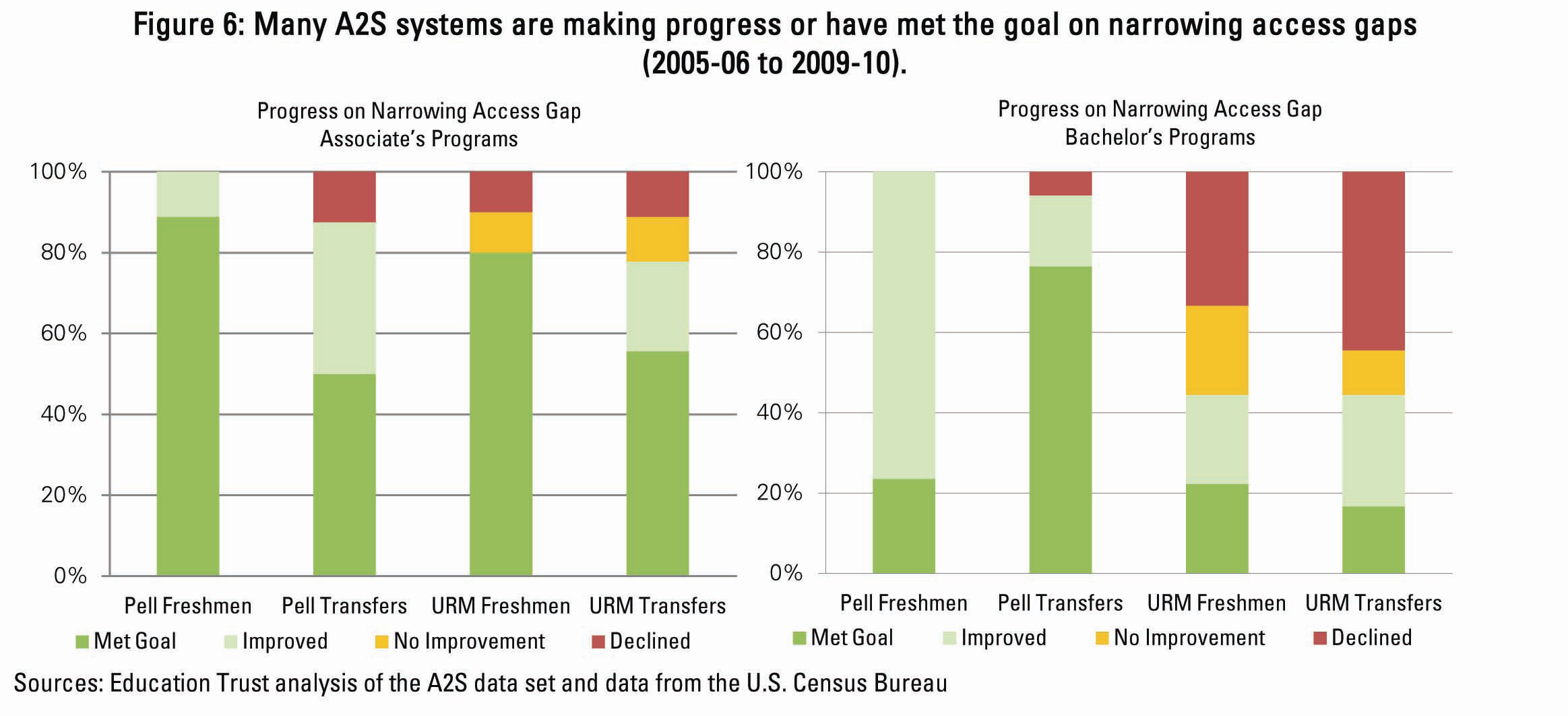
As seen in the figure below, most of the 22 systems had either met (or made meaningful progress toward) their goal of cutting in half the access gap for low-income students. But the figure shows significantly less success in reducing the gap for underrepresented minority students.
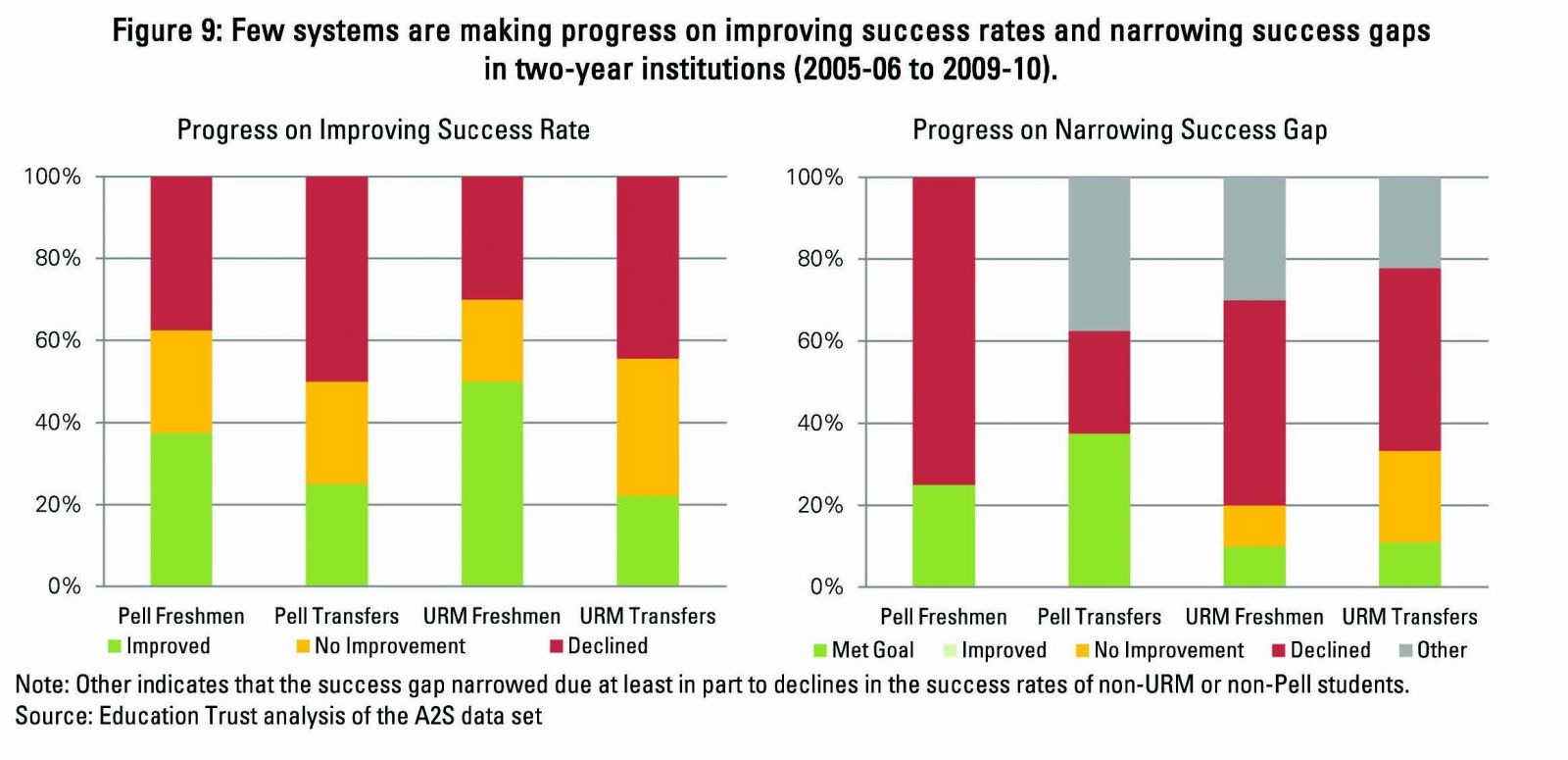
As seen in the figure below, though, the public-college systems (whose enrollments range from roughly 35,000 in the Connecticut State University and South Dakota systems to those in California and New York that are more than 10 times that size) have made far less progress so far on measures focused on student persistence and completion rather than enrollment.
Systems of two-year colleges were as likely to see their success rates for low-income and minority students decrease than improve from 2005-6 to 2009-10, and the gap between the success rates for low-income and minority students and those for all other students grew in many systems.
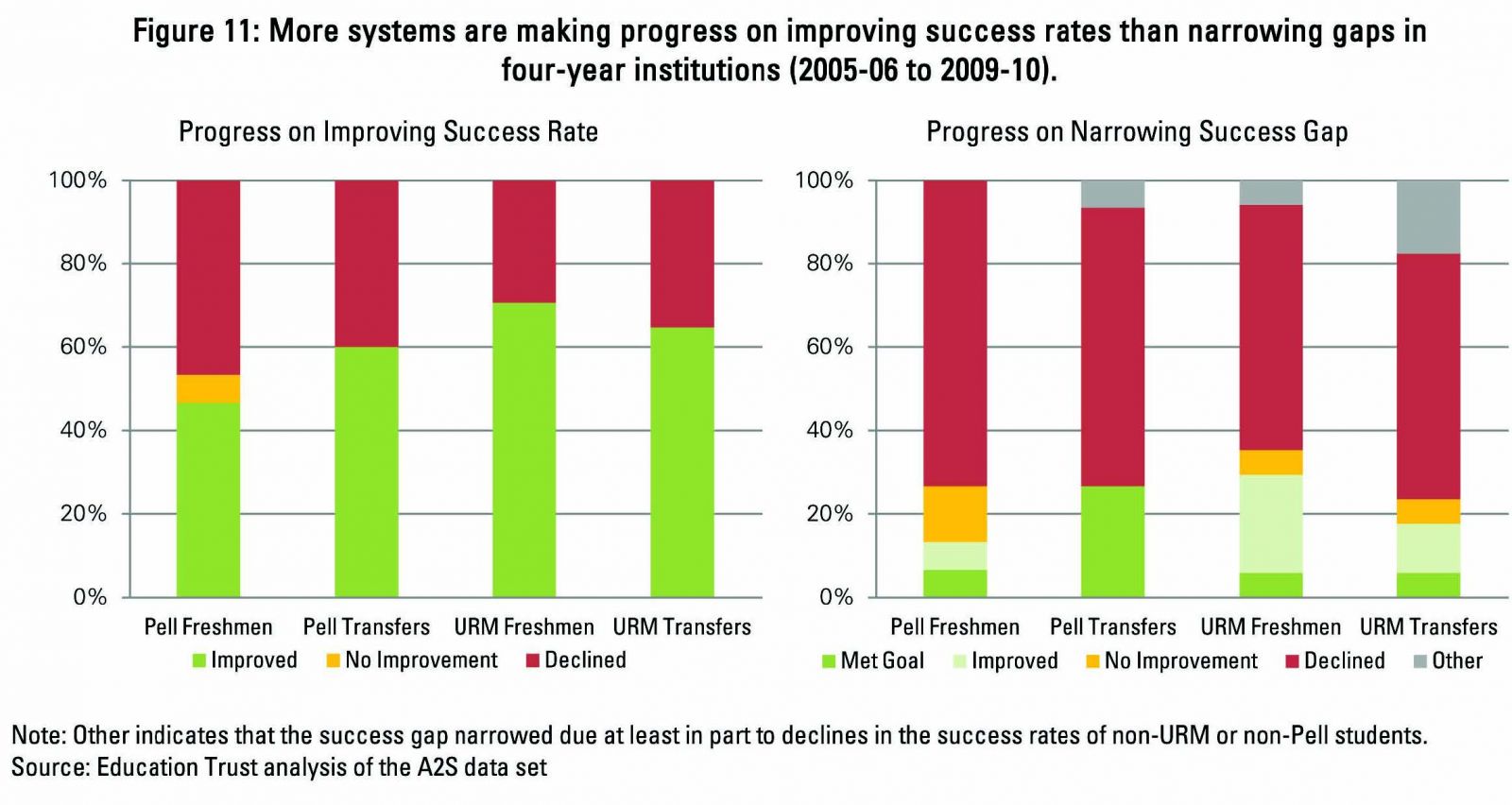
More than three in five of the participating Access to Success systems, meanwhile, have seen their six-year graduation rates for minority and low-income students rise at their four-year colleges, though the relatively few have made progress on closing the success gaps for those students.
The report calls out individual institutions and systems that have made particular good progress in various areas (San Diego State and Florida State Universities for closing racial and socioeconomic gaps, for instance, and the City University of New York and University of Wisconsin Systems for improved success rates in two-year institutions). Its authors, in interviews, note that the work that these systems began when they committed to the project in 2007 has been made much harder, in many cases, by a combination of exploding enrollments and vanishing budgets in the wake of 2008's economic downturn.
"It speaks volumes about the willingness and commitment of system leaders that regardless of what the context looks like or the boundary conditions they're facing, they're showing there is still work that can be done toward increasing educational attainment," said José L. Cruz, vice president for higher education policy and practice at Education Trust and one of the report's authors.
He said it was particularly noteworthy that two systems, the University of Texas and Colorado State University Systems, have newly joined the Access to Success group.
Working with (and to some extent prodded by) Education Trust, which promotes the educational success of low-income and minority students, the 22 systems of two-year and four-year colleges and universities committed to increasing their attainment levels, in large part by closing the gaps in performance between underrepresented students and their peers within a decade. And they committed, too, to documenting their progress by collecting and publicly reporting detailed (and in some cases, previously unreported) data on student access and success.
In a report released Thursday, Education Trust and the National Association of System Heads, collaborators on the "Access to Success Initiative," lay out how the initiative as a whole and the individual systems have fared at roughly the midpoint of the project.
The results, as one might have predicted, are mixed. On the positive side, the 300-plus community and four-year colleges in the 22 systems collectively enrolled 42 percent more low-income students and 23 percent more black, Latino and American Indian students in 2009-10 than they did in 2005-6. The four-year institutions among the group's member systems also cut to 6 percent from 12 percent the difference between the representation of low-income students in their freshmen classes and the proportion of high school graduates who are from low-income backgrounds.
As seen in the figure below, most of the 22 systems had either met (or made meaningful progress toward) their goal of cutting in half the access gap for low-income students. But the figure shows significantly less success in reducing the gap for underrepresented minority students.
As seen in the figure below, though, the public-college systems (whose enrollments range from roughly 35,000 in the Connecticut State University and South Dakota systems to those in California and New York that are more than 10 times that size) have made far less progress so far on measures focused on student persistence and completion rather than enrollment.
Systems of two-year colleges were as likely to see their success rates for low-income and minority students decrease than improve from 2005-6 to 2009-10, and the gap between the success rates for low-income and minority students and those for all other students grew in many systems.
More than three in five of the participating Access to Success systems, meanwhile, have seen their six-year graduation rates for minority and low-income students rise at their four-year colleges, though the relatively few have made progress on closing the success gaps for those students.
The report calls out individual institutions and systems that have made particular good progress in various areas (San Diego State and Florida State Universities for closing racial and socioeconomic gaps, for instance, and the City University of New York and University of Wisconsin Systems for improved success rates in two-year institutions). Its authors, in interviews, note that the work that these systems began when they committed to the project in 2007 has been made much harder, in many cases, by a combination of exploding enrollments and vanishing budgets in the wake of 2008's economic downturn.
"It speaks volumes about the willingness and commitment of system leaders that regardless of what the context looks like or the boundary conditions they're facing, they're showing there is still work that can be done toward increasing educational attainment," said José L. Cruz, vice president for higher education policy and practice at Education Trust and one of the report's authors.
He said it was particularly noteworthy that two systems, the University of Texas and Colorado State University Systems, have newly joined the Access to Success group.
Grad students response to Riley's post on African American Studies
Northwestern AfroStudies Doctoral Students weigh in on the significance of African American Studies Departments
Read it here
Tuesday, May 1, 2012
Vice Dean at U. of Pennsylvania Resigns After Bogus Doctorate Is Exposed


April 26, 2012
Vice Dean at U. of Pennsylvania Resigns After Bogus Doctorate Is Exposed
A vice dean at the University of Pennsylvania resigned on
Thursday after it was revealed that he had misrepresented his academic
credentials.
Douglas E. Lynch, vice dean of the university's Graduate School of Education, quit after having falsely claimed on his résumé that he received a doctoral degree in philosophy, economics, and education from Columbia University.
Penn officials initially told The Philadelphia Inquirer on Wednesday that they had known about the misrepresentation for several months, had levied "appropriate sanctions," and had decided to keep Mr. Lynch in his leadership role. But later on Wednesday, after an Inquirer reporter sought comment from Amy Gutmann, Penn's president, the university changed its tune and immediately placed Mr. Lynch on leave "pending the outcome of an ongoing investigation."
On Thursday the university accepted Mr. Lynch's resignation, and it now "considers the matter closed," Stephen J. MacCarthy, vice president for university communications, said in an e-mail.
Mr. Lynch was admitted to a Ph.D. program in philosophy at Teachers College of Columbia University, according to Columbia, but he has not yet received a degree. Mr. Lynch is currently enrolled in the program, and has until the end of the spring 2012 semester to complete all the requirements for the degree, according to Columbia.
A spokeswoman for the graduate school at Penn told the Inquirer that Mr. Lynch had mistakenly believed his doctoral degree was complete.
Columbia said Mr. Lynch did receive a master's degree in philosophy at Teachers College in 2010. The Inquirer reported that Mr. Lynch had misstated information about that degree, too, saying on his faculty Web page at one point that he received the master's degree in 2005. That same faculty Web page also incorrectly stated that Mr. Lynch completed his doctorate in 2007, according to the Inquirer.
A version of Mr. Lynch's résumé that was available on Penn's Web site on Thursday morning listed the doctoral degree from Columbia, but it did not list any dates for any of his degrees. The file showed that the résumé was last modified in February.
Mr. Lynch's résumé also lists an M.B.A. in finance from New York University and a B.A. in economics from Arizona State University. Both institutions confirmed that Mr. Lynch had indeed received those degrees, in 1995 and 1987, respectively.
Mr. Lynch was hired by Penn in 2004. He previously worked at New York University, the College Board, and Arizona State University, according to his résumé. He did not respond to a request for comment on Thursday.
Correction (4/30/2012, 5:08 p.m.): This article originally stated imprecisely where Columbia University said Mr. Lynch received a master's degree in philosophy in 2010. It was at Teachers College at Columbia, not at Columbia itself. The article has been updated to reflect this correction.
Douglas E. Lynch, vice dean of the university's Graduate School of Education, quit after having falsely claimed on his résumé that he received a doctoral degree in philosophy, economics, and education from Columbia University.
Penn officials initially told The Philadelphia Inquirer on Wednesday that they had known about the misrepresentation for several months, had levied "appropriate sanctions," and had decided to keep Mr. Lynch in his leadership role. But later on Wednesday, after an Inquirer reporter sought comment from Amy Gutmann, Penn's president, the university changed its tune and immediately placed Mr. Lynch on leave "pending the outcome of an ongoing investigation."
On Thursday the university accepted Mr. Lynch's resignation, and it now "considers the matter closed," Stephen J. MacCarthy, vice president for university communications, said in an e-mail.
Mr. Lynch was admitted to a Ph.D. program in philosophy at Teachers College of Columbia University, according to Columbia, but he has not yet received a degree. Mr. Lynch is currently enrolled in the program, and has until the end of the spring 2012 semester to complete all the requirements for the degree, according to Columbia.
A spokeswoman for the graduate school at Penn told the Inquirer that Mr. Lynch had mistakenly believed his doctoral degree was complete.
Columbia said Mr. Lynch did receive a master's degree in philosophy at Teachers College in 2010. The Inquirer reported that Mr. Lynch had misstated information about that degree, too, saying on his faculty Web page at one point that he received the master's degree in 2005. That same faculty Web page also incorrectly stated that Mr. Lynch completed his doctorate in 2007, according to the Inquirer.
A version of Mr. Lynch's résumé that was available on Penn's Web site on Thursday morning listed the doctoral degree from Columbia, but it did not list any dates for any of his degrees. The file showed that the résumé was last modified in February.
Mr. Lynch's résumé also lists an M.B.A. in finance from New York University and a B.A. in economics from Arizona State University. Both institutions confirmed that Mr. Lynch had indeed received those degrees, in 1995 and 1987, respectively.
Mr. Lynch was hired by Penn in 2004. He previously worked at New York University, the College Board, and Arizona State University, according to his résumé. He did not respond to a request for comment on Thursday.
Correction (4/30/2012, 5:08 p.m.): This article originally stated imprecisely where Columbia University said Mr. Lynch received a master's degree in philosophy in 2010. It was at Teachers College at Columbia, not at Columbia itself. The article has been updated to reflect this correction.
Tuesday, April 24, 2012
Obama and Duncan Begin Push to Avoid Doubling of Student-Loan Interest Rate
Washington
President Obama and Secretary of Education Arne Duncan are ramping up efforts to build public support for a way to prevent the interest rate on some student loans from doubling in July.
The interest rate on subsidized Stafford loans is set to double, from 3.4 percent to 6.8 percent, on July 1. The change would affect more than seven million student-loan borrowers, who would incur an extra $1,000 in total interest charges for each loan, according to Mr. Duncan.
After visiting colleges in Wisconsin and Iowa on Thursday, Mr. Duncan spoke at a White House briefing on Friday to promote the seemingly quixotic task of persuading Republicans in Congress to preserve the lower interest rate.
"At a time when college has never been more important, it also, unfortunately, has never been more expensive," he said at the briefing. "Our administration is doing more than ever before to address it."
For his part, the president will make stops next week at flagship public universities in Colorado, Iowa, and North Carolina—which also happen to be swing states in the presidential election—to press this issue and promote his overall higher-education agenda. Mr. Obama will speak at the Universities of Colorado at Boulder, Iowa, and North Carolina at Chapel Hill. He will preview his remarks in his regular Saturday radio address. The White House also has rolled out a social-media campaign using the hashtag #DontDoubleMyRate.
The interest-rate problem stems from 2007, when Congress voted with bipartisan support to cut the Stafford interest rate in half by 2011, from 6.8 percent to 3.4 percent. The cut cost an estimated $7.2-billion from 2007 to 2012, a total that was absorbed almost entirely by lenders and loan-guarantee agencies, according to the Congressional Budget Office.
But in the years since then, student-loan debt has burgeoned, surpassing the $1-trillion mark and exceeding the nation's total credit-card debt for the first time. Student debt has also grown as an issue, gaining power as college costs have continued to rise and a sluggish economy has failed to produce jobs for many college graduates. The issue has been particularly potent among young people, and is a key concern of the Occupy protesters. In March college students delivered 130,000 letters to Congressional leaders to protest the expiration of the lower interest rate.
Bills introduced in both chambers in January aim to extend the 2007 measure for one more year, but they are unlikely to gain traction in Congress. The bills (HR 3826 and S 2051) were introduced by Rep. Joe Courtney, a Democrat of Connecticut, and Sen. Jack Reed, a Democrat of Rhode Island. The Congressional Budget Office estimates that the bills would cost $6.7-billion.
Though the Republican-controlled House of Representatives is unlikely to support the bill, Mr. Duncan said the administration would continue to negotiate on Capitol Hill in an attempt to pass it by July.
"We need to fix it now, we have an immediate crisis," he said at the White House briefing. "I could care less about politics and ideology. This is about, We need an educated work force."
Republican lawmakers have called the proposal a temporary solution, and have said the responsibility to keep tuition affordable should fall to colleges, not the federal government. Rep. John Kline, a Republican of Minnesota and chairman of the House Committee on Education and the Workforce, said extending the low interest rates would unfairly burden taxpayers.
"I have serious concerns about any proposal that simply kicks the can down the road and creates more uncertainty in the long run—which is what put us in this situation in the first place," he said in a news release. "My colleagues and I are exploring options in hopes of finding a responsible solution that serves borrowers and taxpayers equally well."
Correction (4/23/2012, 2:29 p.m.): This article originally misstated one effect of the student-loan interest-rate change on July 1. As a result of the change, each borrower would incur an extra $1,000 in total interest charges, not annual interest charges. The article has been updated to reflect this correction.
Educational Testing Service Will Allow GRE Test Takers to Choose Best Scores
Scott Jaschik
The Educational Testing Service is announcing today that applicants to graduate school will no longer have to submit all their scores on the Graduate Record Examinations, but will have the option to select the best scores to share.
The move is similar to one made by the College Board with regard to the SAT in 2008. For test takers who worry about having an “off day,” the shift is likely to be popular, as they will gain the option of retaking the test without flagging for admissions offices that they once had a low score. ETS will require an entire administration to be submitted, so a test-taker couldn't submit part of a GRE score from one day and another from another day.
ETS may gain from the move in its competition with the Graduate Management Admission Council. ETS has been promoting the GRE for use in business school admissions. While the GMAC’s Graduate Management Admission Test is the dominant exam in M.B.A. admissions, that test is not focused on business-related questions, and ETS has been encouraging applicants to submit GRE scores instead of GMAT scores. Currently all GMAT scores must be submitted, so the new GRE policy could sway some business school applicants to consider that exam. But ETS is also facing some questions over whether the move will simply encourage more students to take the test multiple times, and to get expensive test coaching (practices typically utilized by wealthier applicants, but not those from low income levels.)
David Payne, vice president and chief operation officer for higher education at ETS, said that the organization wanted "to give test takers more confidence on test day and encourage more people to pursue graduate or business school." And he said that ETS was going to expand its fee waiver program (the basic fee is $160 in the United States), which has been limited to one per individual, so that people could seek waivers on more than one examination. He said that research by ETS suggests that all test-takers will have "more confidence," knowing of the new policy.
Bob Ludwig, director of public affairs at GMAC, said that group does not plan to match ETS on score choice, and that there is value (to admissions officers) in reporting all scores. "GMAT test reports are reported fairly. They have a full report of a candidate's testing history, and admissions officers look at the GMAT for more, not less insight into a candidate's skills and abilities." Sometimes, he said that look may result in information that favors a candidate, as when a candidate submits two scores, and did better on one portion on one test and an another portion on the second test. But whether the full testing history helps or hurts a candidate, "admissions departments tell us that they want the full picture," Ludwig said.
Payne of ETS said that graduate programs that want all test scores could tell applicants of such a requirement.
Generally, those who rely on standardized admissions testing or who track the industry agreed that applicants would like the concept of score choice being applied to the GRE.
"Applicants will love it, as they ask us this all the time if we can select the 'best scores' for their application," said Thomas P. Rock, executive director of enrollment services at Teachers College, Columbia University. Rock said that admissions officers at his institutions in fact want to view “the score that puts the applicant in the best possible light,” but he added that there may be other things that could be lost with score choice. "From our perspective, we do like to receive the full picture to see how many times a student has taken the GRE and whether they have improved over time," he said. "The current system of receiving scores allows us to consider everything in an individualized and holistic manner."
Robert Schaeffer, public education director for FairTest: National Center for Fair and Open Testing (a group that regularly criticizes ETS), said that the change "is certainly good for test takers because it eliminates the possibility that one day's poor performance becomes a 'Scarlet Letter' permanently attached to an individual's record."
But Schaeffer was skeptical that ETS was acting only out of concern for the stress of test takers. He said that the ETS bottom line would benefit because of an improved position for the GRE versus the GMAT, and a likely increase in the number of people taking the GRE multiple times. "It will encourage some aspiring grad school students to take the GRE more often, knowing that a poor score can be withheld, thus treating it as a practice test until a desirable result is obtained," he said.
Education for All? 2-Year Colleges Struggle to Preserve Their Mission
Will community colleges only benefit those who are "best prepared" for college? What are your thoughts on this article?
The open-door policy at community colleges is unique in American higher education. It allows all comers—a retired grandmother, an Army veteran, a laid-off machinist—to learn a skill or get a credential. That broad access—the bedrock of the community-college system—has prepared hundreds of millions of people for transfer to four-year colleges or entry into the work force.
But these days, the sector finds itself in a fight to save that signature trademark. As budgets dwindle and the pressure to graduate more students grows, community-college educators from instructors to presidents worry about the future. Less state and local money is making its way to college coffers, prompting painful choices. And the clarion call for the sector to produce more graduates, part of a nationwide effort to boost education levels, has forced colleges to use scarce resources for degree programs rather than for remedial courses.
The focus now is on the best-prepared students, and not on those who may never graduate. Community colleges foresee a day when access to all is no longer the norm but the exception.
"Community colleges are being hammered to increase graduation rates," says Gary D. Rhoades, a professor of higher education at the University of Arizona, who also works with the Center for the Future of Higher Education, a research group. "One way to do that is to change the sort of student you serve." Such a shift would profoundly affect the millions of low-income and minority students who look to attend community colleges every year, many of whom need remedial education first.
Enlarge Image
Noah Berger for The Chronicle
Matthew Wetstein, interim vice president for instruction at San Joaquin Delta College, says the changes his college has undertaken have been difficult to watch. "To me, it's like we are turning our back on the students most likely to benefit from our help."
Enlarge Image
Noah Berger for The Chronicle
San Joaquin Delta no longer offers GED-test preparation. It refers students to other providers, such as the San Joaquin County's Career and Technical Education Center (above).
Enlarge Image
Noah Berger for The Chronicle
While many elementary English-as-a-second-language classes have been cut, Yi Shen is one of the more fortunate students; she can still study English at San Joaquin Delta College.
In a report in February, the American Association of Community Colleges sounded the alarm on how the national completion agenda is starting to affect community colleges. "In policy conversations," it said, "there is a silent movement to redirect educational opportunity to those students deemed 'deserving.' "
That is an uncomfortable thought for a sector that prides itself on being all things to all people all the time: offering English-language classes for immigrants and enrichment programs for senior citizens. But early evidence suggests that some community colleges are already making judgment calls about whom they educate, and how.
Many of those decisions center on remedial education, long an obstacle to improving graduation rates. Academically unprepared students are usually required to enroll in a sequence of remedial courses to get ready for college-level work. More than 60 percent of students at two-year colleges are steered into developmental education, according to the Community College Research Center at Columbia University's Teachers College. Because a considerable number of students place into the bottom rung of those courses, it tends to take them a year or more to complete the sequence. Many fail, or do not progress, and just drop out.
Labeling low-level remedial courses a "dead end" has become some administrators' rationale for eliminating them.
As priorities shift, remedial students are not the only targets. College officials say they feel pressure to scale back or cut other programs that don't lead directly to certificates or associate degrees. Among those are English as a second language and general-equivalency diploma courses. For those services, colleges are redirecting students to other providers: public schools, libraries, nonprofits, and local government agencies.
Such changes are difficult, but as budgets shrink and pressure grows—along with enrollment—they may be inevitable. Yet such new policies, some administrators argue, will compromise the many missions of community colleges.
At the same time, demographic shifts are likely to result in more community-collegegoers. Right now, nearly half of all minority undergraduates attend a community college, according to their association, and the U.S. Census projects that minority populations are growing. Many of those future students will probably turn to community colleges.
They will need an open door, says Kay M. McClenney, director of the Center for Community College Student Engagement at the University of Texas at Austin. "The students who we turn away are the demographic future of America."
Opportunities Denied
It is already hard to enroll at some community colleges. More than 400,000 prospective students have been denied that opportunity because of institutions' budget-driven moves to limit academic programs and restrict enrollment.
California is a case in point. The community-college system there is one of the largest in the country, with 2.6 million students, or nearly 25 percent of enrollment in the sector nationwide. And it is facing severe budget cuts: The state has slashed its appropriations by 13 percent over the last three years. As a result, the California Community Colleges have had to offer fewer courses, says Jack Scott, the system's chancellor.
"We are being forced to ration enrollment," Mr. Scott says.
In January a panel convened by the system to improve students' success released a set of 22 recommendations, some of which straddle the line between promoting success and limiting access. One measure will give priority in registering for classes to students who have taken a placement test, participated in orientation, and developed an educational plan. All students must identify a program of study within three semesters, or they will lose that priority, Mr. Scott says.
Those and other policies will give spots to the most likely graduates. An associate degree takes 60 credits; students who have accumulated more than 110 credits, excluding ESL and remedial courses, will find themselves at the end of the registration line.
"Too many students are just lingering in the system," says Mr. Scott. Their seats, he says, could be occupied by those who are more serious.
But limiting access isn't the right way to think of that, Mr. Scott insists. "We are prioritizing access," he says.
Community colleges like those in the California system are in a quandary. Across the country, two-year colleges face a charge to graduate more students but have little money to do it.
The Obama administration put the sector front and center in its plan for all Americans to obtain at least one year of postsecondary education or training. Other groups are on board—the National Governors Association, the Lumina Foundation for Education, Complete College America—and the recognition of community colleges is on the rise.
But the push comes as the federal government hasn't followed through on a promise of more money for the sector. In 2009 the administration proposed spending $12-billion to rebuild crumbling facilities, improve remedial education, raise the number of students who graduate and transfer to four-year colleges, and forge stronger ties between colleges and employers. But the plan, known as the American Graduation Initiative, was gutted during negotiations over legislation to overhaul student-aid programs and the nation's health-care system. The law that ultimately passed left community colleges with only $2-billion for a career-training program administered by the Department of Labor.
President Obama's budget proposal for the 2013 fiscal year includes $8-billion for a Community College to Career Fund, but Congress is unlikely to pass a budget until after the election in November.
That leaves community colleges to fend for themselves financially. It probably also means more cuts in programs and services, more students shut out of classes due to lack of classroom space, and more tuition and fee increases.
"I know no reasonable person who thinks that if we just hold our breath through this recession that the money will roll back in," says Ms. McClenney, of the Center for Community College Student Engagement.
She worries about where students, especially those from vulnerable populations, will go if a community college can't give them the help they need. The place she fears most, she says: "the curb."
Remediating a Problem
If raising graduation rates is the goal, remediation is the biggest hurdle. Nationally, two-year colleges spend more than $2-billion a year helping students improve their English and mathematics skills, according to Community College Research Center at Teachers College. Many institutions have little to show for that effort: Fewer than 25 percent of students who enroll in remedial courses make it to graduation, the center says.
That has been considered a waste of time and money—both students' and colleges'. Administrators working with limited budgets and fed up with dismal graduation rates are trying new tactics.
At Jackson Community College, in Michigan, students who test below a seventh-grade reading level are referred to remedial programs elsewhere, such as public agencies like South Central Michigan Works.
Sending students elsewhere—and cutting their tie to a college—is risky, says Carol Lincoln, a senior vice president at Achieving the Dream, a nonprofit group dedicated to increasing college degrees.
"That may be practical and economically smart," she says. "But it's a problem if that is all we are doing and we don't create a bridge for those students to come back to us.
Other colleges are taking a different approach, beginning with a philosophical shift: acknowledging that some students just aren't prepared for the rigors of college-level work. At Palo Alto College, in San Antonio, administrators have become more realistic over time, says Ana Margarita Guzman, its president. "We did everything we could do to help students," she says, recalling years past, "but sometimes it still wasn't enough."
Now the college is trying to identify students with good academic potential and redirect others. Before taking placement tests, students are required to enroll in a free, two-week, test-preparation course. "Now we have students skipping two or even three courses," Ms. Guzman says.
But not every student does well on the placement test; some have entered the college with very low academic skills. Palo Alto encourages those students to pursue work-force-related certificate programs, which don't require remedial coursework first—and allow for a quick transition into employment.
The certificate programs must be tied to an associate degree, administrators decided, because they hope students will return to the college. "What we have found is that maturity helps and that success in the workplace builds confidence, which helps students to succeed when they come back to restart their academic careers," Ms. Guzman says.
Such approaches are recasting the sector's role in economic terms, to fuel work-force development, says Mr. Rhoades, of the Center for the Future of Higher Education. He is skeptical of that, calling it an unsafe "rebooting" of community colleges.
Concentrating more on job training, Mr. Rhoades says, and less on, say, providing the general-education courses needed by students planning to transfer, narrows the sector's educational purpose.
Shifting Missions
The notion that community colleges will continue to serve all types of students is starting to slip away. More institutions these days are focusing on one of two so-called core missions: training students for the work force with quick certificates or associate degrees, or preparing them for transfer to higher levels of education.
That leaves less room for many other missions: to educate English language learners, for example, or people pursuing a general-equivalency diploma. Even senior citizens are being squeezed out. At Wor-Wic Community College, in Maryland, "senior only" classes are no more. Money used for them has been redirected to support services to help students graduate, says Murray K. Hoy, the college's president.
Moves like those threaten the important local role community colleges have long played. In many ways, the institutions are the lifeblood of small cities and towns. They have offered a rich array of resources, including entrepreneurial programs, Zumba dance classes, arts festivals, and citizenship preparation.
But it's increasingly difficult to keep being everything to everybody. Recent changes at San Joaquin Delta College, in Stockton, Calif., have been agonizing, says Matthew Wetstein, interim vice president for instruction. The college has seen its share of state money slashed by roughly 25 percent since 2009. Another reduction of about $5-million is expected in the next academic year. Those crippling cuts have forced San Joaquin Delta to perform a "cold, deliberate cost-benefit analysis," he says.
As a result, community music and arts classes, as well as recreational programs for senior citizens, are no longer available at the college. The general-equivalency-diploma program is gone, as are the lowest levels of English as a second language. The college now refers students seeking such services to its continuing-education department, or to the San Joaquin County Office of Education.
All this has created a bit of a furor among faculty who see the moves as rationing access, by focusing too exclusively on students poised to earn certificates or degrees. Some instructors have argued that students who want to learn English as a survival skill, to communicate with co-workers or doctors, should be able to do that at the college, says Mr. Wetstein.
But policy makers and associations want to see a single figure: completions. How many students graduated? How many didn't? It's hard to measure people's personal and social development. "The traditional benchmarks for success don't apply," he says.
The intangibles that community colleges offer, Mr. Wetstein says, are being lost in the completion movement led by the Obama administration and nonprofit groups.
"The community is being stripped out of community college," he says. "It's incredibly painful to watch."
The Real Cost of Education
Is encouraging students to take out loans the way to go? Especially with lawmakers attempting to raise the interset raise so that students pay an additional $1,000 dollars a year to loan debt? Can we find more afforable and economical solutions for our students?
http://www.foxbusiness.com/personal-finance/2012/04/23/is-education-still-worth-debt/
http://www.foxbusiness.com/personal-finance/2012/04/23/is-education-still-worth-debt/
Monday, April 23, 2012
Thursday, April 12, 2012
ICE grants DREAM Act student another year in AZ
PHOENIX (CBS5) -
CBS 5 News has learned that an illegal immigrant who grew up in Arizona and dreamed of becoming a U.S. Marine will not be deported Tuesday after all.
Immigration and Customs Enforcement has reversed its earlier decision and granted Pedro Gutierrez, of Casa Grande, an additional year in the United States, according to Mo Goldman, the attorney for Gutierrez, on Thursday.
ICE confirmed to CBS 5 News that it has granted the reprieve, a move Goldman called "good news."
ICE spokeswoman Amber Cargile said the stay of removal for one year was based on humanitarian grounds.
Gutierrez was granted a one-year stay in 2011 after support from numerous activists organizations.
Gutierrez was brought to Arizona by his grandmother when he was 7 years old. After she died, Gutierrez went on to graduate from high school with the support of his community.
Without immigration papers, all he had to count on for his future was the DREAM Act, which lawmakers were unable to pass.
Had the legislation been enacted, Gutierrez would have had the opportunity to attain citizenship once he completed at least two years in the armed forces.
In 2009, a traffic violation - driving without a license - landed him in jail and subsequent ICE investigation.
He was due to be deported January 2011, but the massive outpouring of support helped him gain a 30-day stay, followed by a year-long stay that would have ended next week.
"If I go back to Mexico, I have no home there, I have no family, no friends, nothing," Gutierrez told CBS 5's Donna Rossi. "If I go back, I'll be homeless."
Gutierrez has an 8-month-old daughter and a 4-year-old stepson.
This article is very interesting what are your thoughts??
Wednesday, April 11, 2012
Future of Liberal Arts College
Daniel H. Weiss, president of Lafayette College in this article reports his fear that Liberal Arts Colleges in the near future will become obsolete because of 4 major themes he has identified. Those themes include affordability, skepticism about the successfulness of institutions of higher education, shifting demographics, and technology. The theme that struck me the most was the shifting demographic. Weiss states “The challenge for us is not that diversity is not a great thing—it’s a
great thing,” Mr. Weiss said. “Our challenge is that for many
liberal-arts colleges … the decrease in enrollments in traditional areas
of strength requires us to develop our story and a new way of reaching
out.”
I'm not sure about you, but to me it would seem as though Colleges and Universities should be willing to reach beyond their majority population to encourage others to attend. And what is to be said about the use of "traditional areas of strength" especially when Weiss projects "Within 10 years, nonwhite children will make up more than half of all children in the United States, rising to 62 percent by midcentury".
Read the article here A President Surveys the Future of Liberal Arts Colleges
I'm not sure about you, but to me it would seem as though Colleges and Universities should be willing to reach beyond their majority population to encourage others to attend. And what is to be said about the use of "traditional areas of strength" especially when Weiss projects "Within 10 years, nonwhite children will make up more than half of all children in the United States, rising to 62 percent by midcentury".
Read the article here A President Surveys the Future of Liberal Arts Colleges
Tuesday, April 10, 2012
For Student Success, Stop Debating and Start Improving
I have seen up close the multiple challenges that face higher education in these times of budget cuts and increased public concern over the value and cost of college. Yet in my experience, three broad but unproductive areas of debate distract us from solving the central challenges. Here's what ought to be happening:
1) Institutions should improve student success by focusing on practices within their control instead of blaming external factors.
2) Give students more-structured academic programs that accelerate their progress toward degrees.
3) Accept that preparing for work and pursuing a liberal-arts education are not mutually exclusive.
What are we learning about the best path forward to solve the real problems? While critics worry that the Gates Foundation may try to force its agenda on higher education, we see our role as funding diverse approaches that allow higher education to create its own solutions. With that in mind, I suggest the following priorities for our concerted attention:
- Optimize the rich higher-education "ecosystem" we've got. America's vaunted higher-education system is not just about public and private nonprofit four-year colleges. Community colleges are an underresourced asset for states and students. The best for-profit institutions offer nimbleness, capacity, and innovation that the rest of higher education can learn from. We need a range of institutions, with better connections among them.
- Fundamentally rethink how we as a society finance the public good of higher education. The disinvestment in public higher education over the past two decades has shifted greater costs and risks to students and their families, and has especially hurt the open-access two- and four-year colleges that educate the majority of college students. Restructure funding streams to motivate institutions to offer, and students to achieve, high-quality credentials, at a reasonable cost and time to degree completion.
- Break the tyranny of the credit hour and ease transfers among institutions. We need the best researchers and the most gifted teachers in higher education to focus on these challenges—like Harvard's Eric Mazur, who has radically redesigned his physics course based on research showing that students in the traditional lecture format had not learned as much as he thought.
- Use all means to increase personalization and student success. The most powerful forms of technology are not simply putting traditional education online but are transforming the process to maximize learning and retention. The tools need not be high tech: Mentors dedicated to helping students navigate their degree programs, like those at Western Governors University, help students persist and succeed. That kind of differentiated role will especially be needed in an "unbundled" world of free course content, where added value will come from figuring out how to support student motivation and progress.
- Accelerate innovations aimed at increasing value while decreasing cost. The Gates Foundation's third Next Generation Learning Challenge attracted strong proposals to create delivery models that can serve a minimum of 5,000 students at a cost of $5,000 or less, with completion rates of 50 percent or more.
- Build organizational infrastructures to guide colleges through this crucial transformation and develop a new breed of leaders to support it. Unlike K-12, which has a wide array of organizations and leaders dedicated to reform (New Leaders for New Schools, new approaches to talent development, technical-assistance providers), this is nascent in higher education.
- Welcome data and be transparent about results. You can't get better unless you know where you are. Institutions and states should focus first on using data to learn how to drive improvement, rather than move to premature accountability systems.
Hilary Pennington is an expert on postsecondary education, most recently serving as director of education, postsecondary success, and special initiatives at the Bill & Melinda Gates Foundation.
Link to full article.
Interesting report; discussed how community colleges are now becoming a deterrence for students of color from low ses
http://www.jbhe.com/2012/04/black-and-minority-students-are-being-squeezed-out-of-community-colleges/?utm_source=rss&utm_medium=rss&utm_campaign=black-and-minority-students-are-being-squeezed-out-of-community-colleges
http://www.jbhe.com/2012/04/black-and-minority-students-are-being-squeezed-out-of-community-colleges/?utm_source=rss&utm_medium=rss&utm_campaign=black-and-minority-students-are-being-squeezed-out-of-community-colleges
Subscribe to:
Posts (Atom)